


Views: 0 Author: Site Editor Publish Time: 2026-08-17 Origin: Site


Stepping onto the green launching a proprietary footwear line is an exciting milestone for any brand. However, developing custom Golf Shoes carries high technical and financial risks. Unlike standard lifestyle sneakers, golf footwear requires precise engineering. Players need reliable torque support, steadfast waterproofing, and exceptional traction to perform at their highest level.
Navigating the complex global supply chain to achieve these features often overwhelms new market entrants. Repurposing casual designs simply will not work for athletes swinging clubs at over 100 miles per hour.
Model Selection: Private label offers a 40% faster time-to-market, while OEM provides absolute control over proprietary swing-stability technology and tooling.
Cost Realities: Initial investments hinge primarily on custom outsole molds ($1,500–$3,000+ per size run) and material MOQ thresholds.
Technical Imperatives: True golf footwear requires specialized waterproof membranes and rotational traction testing, differentiating them from standard sports shoes.
Partner Vetting: Avoid generic trading companies by demanding specialized technical packs (Tech Packs) and verifiable sports shoe compliance certifications.
Defining the commercial boundary between speed-to-market and intellectual property ownership is your first critical decision. You must choose a sourcing model aligning directly to your capital reserves and brand strategy.
Private label manufacturing involves selecting pre-developed, factory-owned shoe molds. You then apply your brand's unique upper designs, colors, and logos to these existing templates. This model heavily reduces initial friction.
It acts as the best route for apparel brands seeking to add footwear as a secondary revenue stream. You can test market demand using significantly lower upfront capital. The primary advantages include zero outsole mold costs and lower Minimum Order Quantities (MOQs). Factories often accept orders of 300 to 500 pairs. Additionally, you benefit from a rapid sampling turnaround, usually securing physical prototypes in just three to four weeks.
OEM manufacturing requires building a shoe from scratch. You base the entire construction on your proprietary technical blueprints, custom lasts, and unique sole tooling. This method provides ultimate design freedom.
Dedicated footwear innovators, biomechanics experts, and scaling Direct-to-Consumer (DTC) companies usually prefer OEM. The main advantages include 100% intellectual property ownership. You build a unique competitive moat because no other brand can access your molds. Furthermore, you can dictate highly tailored performance specifications suited exactly to your target demographic.
Note: While Private Label reduces initial tooling costs, OEM prevents competitors from accessing your exact sole design through the same factory line. To summarize these differences, review the comparison table below.
Feature | Private Label | OEM |
|---|---|---|
Time to Market | Fast (3-4 weeks for samples) | Slow (8-12 weeks for samples) |
Upfront Tooling Costs | Zero (uses factory molds) | High ($1,500 - $3,000+ per size) |
IP Ownership | None (factory owns sole design) | 100% Brand Ownership |
Target Audience | Apparel brands, early-stage startups | Performance brands, DTC innovators |
Establishing product credibility determines your long-term success. You cannot simply repurpose standard Sports Shoes, attach a new logo, and label them for the course. Your product must meet rigorous, sport-specific evaluation criteria.
Traction dictates every powerful golf swing. You must decide between spiked and spikeless architectures. Molded TPU spikeless outsoles offer excellent versatility. Golfers love wearing them straight from the clubhouse to the course. Conversely, traditional receptacle-based spiked soles deliver maximum torque resistance for players seeking aggressive ground interaction.
Regardless of the style, rotational grip remains critical. You must evaluate the lug pattern's ability to anchor the foot. The outsole must endure intense friction during the biomechanical rotation of a full swing without slipping or deteriorating.
Morning dew and unexpected rain ruin poorly designed footwear. Standard DWR (Durable Water Repellent) coatings are entirely insufficient for golf. You must require verifiable waterproof membranes, such as internal bootie constructions. Pair these membranes alongside seam-sealed full-grain leather or engineered microfibers. These layered defenses keep water out while allowing internal sweat vapor to escape.
An average round of golf involves walking five to six miles. You must balance walking comfort using premium EVA or PU foams against essential lateral stiffness. If the midsole feels too plush, players experience power leakage during the downswing. The shoe must stabilize the foot's outer edge to harness kinetic energy effectively.
Best Practice Tip: Always request the factory’s standardized testing protocols before approving prototype materials. Ask to see SATRA testing standards for flex fatigue and waterproof integrity. Reliable manufacturers gladly share their laboratory results.
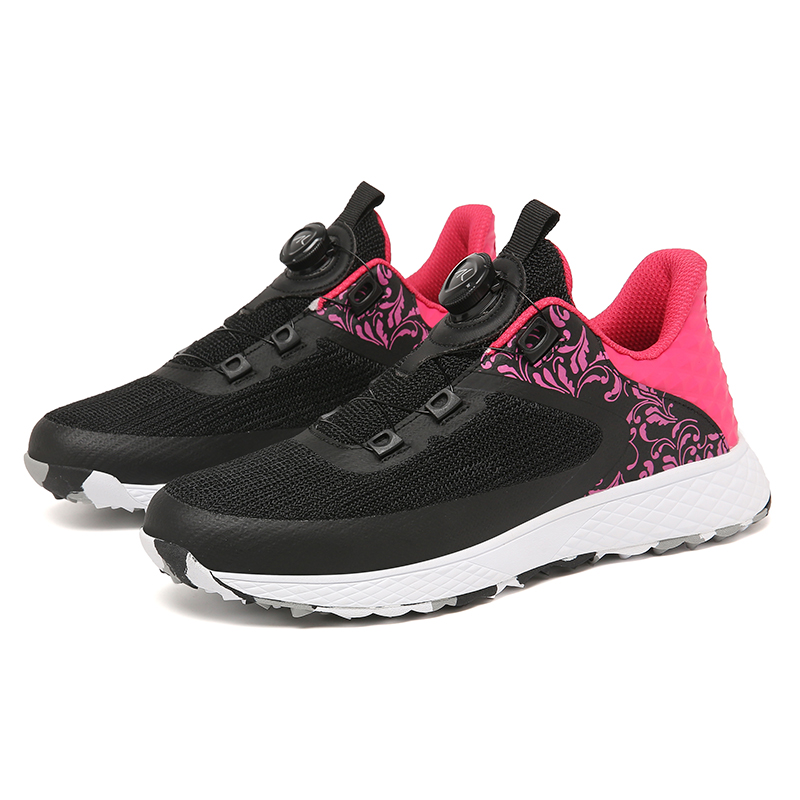
Premium golf footwear requires precision-engineered traction patterns and waterproof construction to ensure peak on-course performance.
Transparent financial planning separates profitable brands from failed ventures. Understanding ROI forecasting for wholesale production helps you allocate capital efficiently. Do not let hidden fees destroy your margins.
OEM projects demand significant upfront capital. You must purchase custom lasts and molds for every half-size in your production run. A typical size run spans from US Men's 7 to 13. Each metal outsole mold costs between $1,500 and $3,000 depending on complexity. Therefore, opening a full size run often requires a $15,000 to $30,000 initial investment before producing a single retail pair. You must factor this heavy tooling cost into your break-even analysis.
Minimum Order Quantities depend heavily on material choices rather than just factory assembly lines. Material-driven MOQs dictate your volume. For example, custom-dyed leathers require much higher volume thresholds than stock black or white materials.
OEM Standards: Expect industry requirements of 500 to 1,000 pairs per colorway. Factories need this volume to justify stopping and resetting their custom assembly lines.
Private Label Standards: Expect requirements of 200 to 500 pairs. Because factories use existing molds and stock materials, they can accommodate smaller test batches.
Design complexity directly scales your FOB (Free on Board) per-unit price. Using BOA fit systems instead of traditional laces adds costly licensing and installation fees. Multiple upper panels increase stitching time. Premium full-grain leathers cost significantly more than synthetic microfibers.
Cost Component | Impact on FOB Price | Cost Reduction Strategy |
|---|---|---|
Closure Systems | High (BOA dials add premium costs) | Use traditional laces for initial launch. |
Upper Materials | Medium to High (Full-grain leather is costly) | Blend synthetic microfiber in low-wear zones. |
Panel Complexity | Medium (More panels mean more stitching labor) | Simplify upper designs to reduce labor time. |
Packaging | Low to Medium (Custom boxes increase volumetric weight) | Opt for standard corrugated boxes initially. |
Understanding the operational workflow from concept to mass production prevents costly delays. Managing this timeline requires tight coordination between your design team and the factory floor.
Step 1: Tech Pack & Blueprinting. Everything begins here. You submit detailed 2D or 3D CAD designs, a comprehensive Bill of Materials (BOM), and exact material specifications. A thorough Tech Pack leaves no room for factory guesswork.
Step 2: Prototyping & Last Development. The factory creates a wooden or plastic foot model, known as the "last". They then produce the first unbranded prototype. You evaluate this sample strictly for foundational fit, volume, and basic performance parameters.
Step 3: Wear Testing & Iteration. Conduct rigorous on-course testing using low-handicap golfers. These players generate extreme ground force. They will quickly identify pressure points, waterproof failures, or traction slipping.
Step 4: Tooling & Size Grading. Once you approve the sample size (usually Men's US 9), the factory opens molds for the full size run. They mathematically scale the dimensions up and down, a process known as grading.
Step 5: Mass Production & QA. The factory sets up the assembly line. Quality assurance teams monitor the process, adhering to AQL (Acceptable Quality Limit) standards. Finally, workers package the finished footwear for container shipping.
Note: Never rush Step 3. Biomechanical flaws in generic Sports Shoes easily hide during casual wear. However, golf shoes will fail immediately under the rotational stress of a 100+ mph swing. Iteration during the testing phase saves your brand's reputation.
Risk mitigation secures your supply chain and prevents costly entanglements middle-men. You must partner directly with reputable facilities capable of executing complex engineering.
You must partner with a factory explicitly manufacturing technical sports footwear. Do not hire factories accustomed to making casual sneakers or dress shoes. Technical factories understand advanced adhesive applications, rigid shank placements, and waterproof membrane integrations. Generalists often struggle to construct footwear capable of surviving extreme rotational torque.
Demand transparency regarding factory conditions and certifications. Look for ISO compliance ensuring consistent quality management systems. Verify ethical labor practices by requesting BSCI (Business Social Compliance Initiative) audit reports. Top-tier partners also maintain in-house testing labs to verify flex points, abrasion resistance, and waterproofing before third-party verification.
Producing custom golf footwear requires balancing upfront tooling investments against long-term brand equity. High-performance engineering separates serious brands from fleeting fashion experiments. As you plan your product roadmap, keep these core actions in mind:
Evaluate your capital thoroughly before choosing between the speed of Private Label and the exclusive IP ownership of OEM.
Prioritize rotational traction and verifiable waterproof membranes over purely aesthetic details.
Audit potential manufacturing partners relentlessly, demanding specialized experience in performance athletics.
Never bypass the on-course wear-testing phase; low-handicap golfers will expose hidden biomechanical flaws.
Your next steps involve compiling a pristine Tech Pack and defining your required MOQ. Once prepared, begin requesting localized samples from specialized footwear manufacturers to kickstart your prototyping journey.
A: The sampling phase typically takes 3 to 4 weeks for Private Label or 8 to 12 weeks for OEM. Once you approve the final prototype and place a purchase order, mass production generally requires an additional 45 to 60 days, excluding ocean freight transit times.
A: Yes. Many factories now source rPET (recycled polyethylene terephthalate) for woven uppers and use recycled EVA for midsoles. However, you must ensure these eco-friendly materials still accommodate robust waterproof membranes to maintain course-ready integrity.
A: MOQ depends on the sourcing model, materials, outsole tooling, and colorway requirements. Private label projects usually support lower order quantities because they use existing molds and established constructions, while fully customized OEM projects generally require higher volumes to justify tooling, material procurement, and production setup. Buyers should confirm MOQ by size range, colorway, and material before starting sample development.


