


Views: 0 Author: Site Editor Publish Time: 2026-08-13 Origin: Site


Entering the athletic footwear market often feels remarkably complex. Brands face intense competition and strict technical demands from everyday athletes. The core challenge lies in balancing rigorous performance requirements against strict manufacturing budgets and crucial speed to market. Launching specialized footwear demands strategic planning and highly reliable supply chain partners. If you ignore these operational realities, you risk significant capital loss and delayed product launches.
This guide provides a transparent, step-by-step framework for evaluating OEM and Private Label manufacturing options. You will discover the practical differences between building a product from the ground up versus customizing existing factory models. We will explore critical material selections, tooling realities, and minimum order quantities in depth. Ultimately, this breakdown equips you to navigate the wholesale footwear ecosystem effectively, ensuring you select the absolute best path for your unique business goals.
Private Label offers faster market entry with lower Minimum Order Quantities (MOQs), while OEM provides complete intellectual property control and custom tooling.
Outsole mold creation is the primary cost driver and bottleneck in custom soccer shoe manufacturing.
Standard sports shoes share manufacturing principles, but soccer shoes require specialized soleplates (FG, SG, Turf) and specialized upper grip technologies.
Factory selection must prioritize technical tech-pack comprehension, independent quality control access, and clear supply chain compliance.
Brands must constantly decide between rapid deployment and total product differentiation. You base this choice largely on current cash flow and desired market positioning. Selecting the right manufacturing model dictates your upfront investment and long-term scalability.
Private label means selecting pre-designed base models from a factory catalog. You then apply custom branding, unique colorways, and minor material tweaks. This approach bypasses heavy engineering phases.
The primary advantages include significantly lower Minimum Order Quantities (MOQs) and the elimination of expensive 3D mold development costs. Brands enjoy drastically reduced lead times, typically bringing products to market in 30 to 60 days.
However, limitations exist. You lack exclusive structural intellectual property. Your product heavily relies on the factory’s existing last and soleplate inventory. Competitors can easily source the same base silhouette, making brand differentiation much harder.
OEM involves building a shoe entirely from scratch. Manufacturers base the production entirely on your proprietary technical drawings, known as a Tech Pack.
This route offers total control over fit, performance specifications, and soleplate configurations. You gain exclusive ownership of all outsoles and molds. Your product remains entirely unique in the marketplace.
The limitations involve high upfront capital. You must pay for expensive tooling and molds for every shoe size. Factories require higher MOQs to justify machine setup. Furthermore, you face extended research and development timelines, often stretching 90 to 120 days or more before mass production begins.
Review the comparison below to evaluate which pathway aligns with your current operational bandwidth.
Variable | Private Label | OEM (Custom) |
|---|---|---|
Setup Costs | Low (No mold fees) | High (Costly per-size molds) |
Time-to-Market | 30–60 Days | 90–120+ Days |
Customization Level | Low to Medium (Colors/Logos) | Maximum (Full Structural Control) |
Best-Fit Scenarios | Market testing, budget constraints | Established brands, disruptive tech |
Tip: If testing a new market segment, start with a Private Label base utilizing high-quality materials to prove demand before investing heavily in custom OEM outsole molds.
Unlike casual Sports Shoes meant for daily walking, athletic cleats require extreme stress tolerance. They need robust lateral support and specialized traction elements to prevent injuries during sharp turns. Understanding these technical nuances separates premium brands from budget alternatives.
Synthetics/Polyurethane (PU): PU materials remain lightweight, highly water-resistant, and cost-effective. Manufacturers easily mold them to enhance ball friction. PU works best for entry-level to mid-tier models where durability and price matter most.
Knits & Wovens: These materials offer a premium feel and a highly sought-after sock-like fit. However, they require specialized computerized factory machinery. Producing durable knitted uppers drastically increases production costs and lead times.
Leather (K-Leather/Calf): Traditional leather serves as a premium performance material offering superior touch and moldability. Sourcing genuine leather involves complex supply chains. You must strictly track ethical sourcing and environmental compliance to satisfy modern retail standards.
The bottom of the shoe dictates its specific use case. Factories must engineer different soleplates based on varying pitch conditions.
Firm Ground (FG) & Soft Ground (SG): These classic configurations require high-density TPU (Thermoplastic Polyurethane) or Nylon plates. High density prevents stud pressure from bruising the athlete's foot during aggressive sprints.
Artificial Grass (AG) & Turf (TF): Artificial surfaces generate massive friction and heat. These outsoles require specific rubber compounds designed for maximum abrasion resistance. They use multi-stud setups to ensure proper weight distribution.
Indoor (IN): Indoor courts demand specialized grip. Factories focus on non-marking gum rubber. They engineer specific pivot-point tread patterns to allow seamless rotation on flat, hard surfaces.
Note: Always specify your target playing surface in the initial factory brief, as this dictates the exact durometer (hardness) of the TPU or rubber compounds the manufacturer must source.
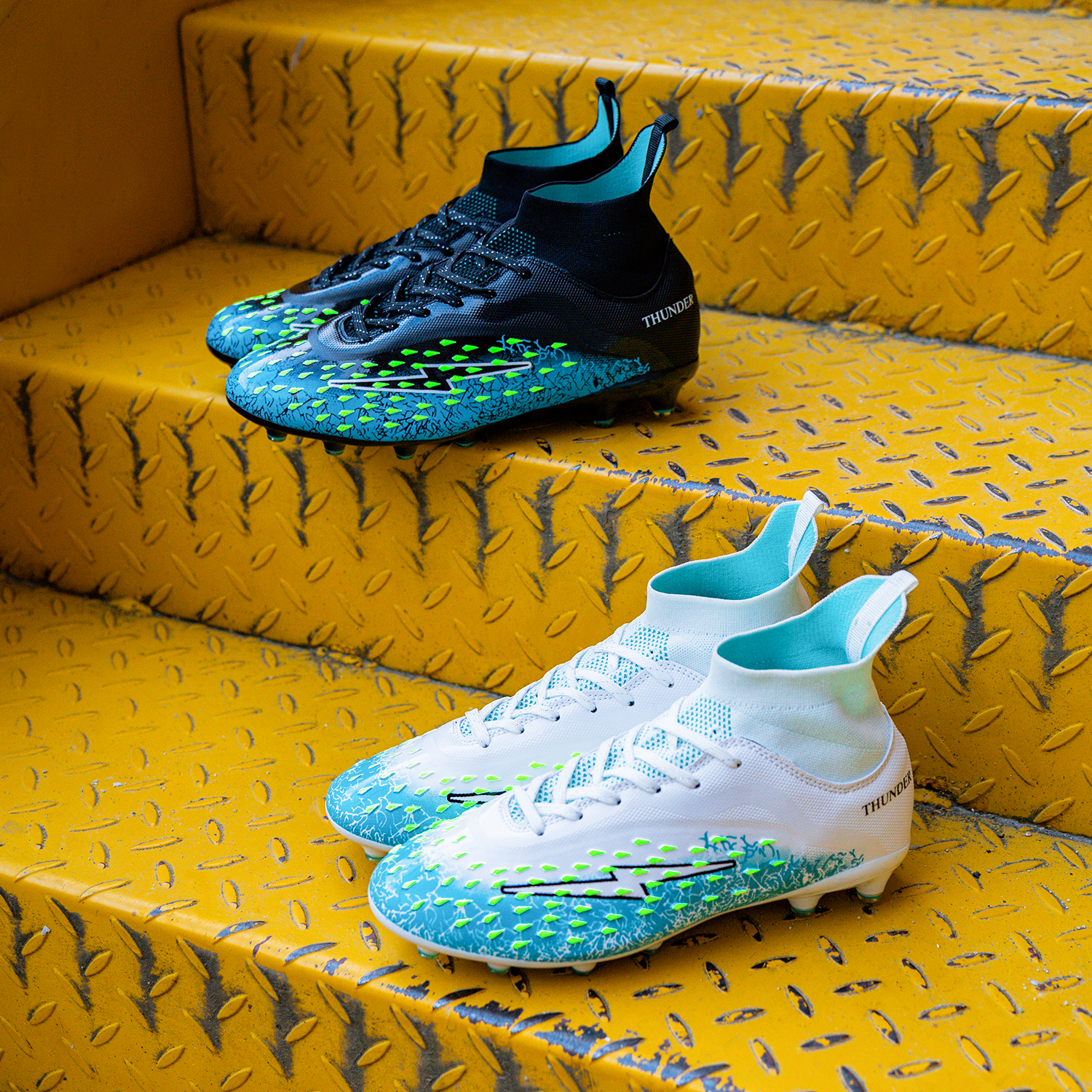
Premium soccer shoe production requires precise upper materials and specialized outsole traction configurations.
Producing reliable Soccer Shoes involves a rigorous, multi-step process. Skipping any phase usually results in defective product runs and wasted capital. The workflow breaks down into five primary stages.
Everything starts with documentation. You submit detailed 2D or 3D CAD drawings to the factory team. This package must include a comprehensive Bill of Materials (BOM) detailing every thread, eyelet, and fabric swatch. You also provide precise grading scales to ensure proper proportioning across all shoe sizes.
Engineers first develop the physical foot mold, known as the "last". The last determines the internal volume and ergonomic fit of the shoe. Next, they cut the steel or aluminum molds for the outsole. Tooling is universally the most critical and expensive step for any OEM project. Any mistake here cascades into mass production.
The factory creates the first pullovers. Pullovers are essentially the upper material stitched together without the sole unit, used to check pattern alignment. Once approved, they produce complete, functional samples combining the upper and the newly injected soleplate.
You cannot judge a cleat purely by its appearance. You must rigorously evaluate the physical sample for dangerous stud pressure, unwanted heel slippage, and overall material durability under heavy athletic stress. Wearers test them aggressively on the designated field surface. Designers then adjust the patterns or soleplates based on direct feedback.
After final approval, mass production begins. Workers cut the upper materials and stitch them together. They then cement the upper to the sole unit. Cleat manufacturing often requires specialized high-pressure presses to ensure the cementing bond survives extreme torsion. Finally, workers clean, lace, and package the footwear.
Tip: Never approve mass production based on a visual sample alone. Insist on a functional "wear-test sample" in your median size and conduct field tests to identify structural weaknesses.
Financial modeling dictates the success of your footwear brand. Miscalculating your initial capital requirements often leads to stalled production and missed seasonal launches.
Footwear manufacturing costs fall into three main categories. Understanding these helps you negotiate better rates.
Cost Category | Nature of Expense | Impact Factor |
|---|---|---|
Tooling/Molds | Fixed upfront cost | Charged per shoe size. A full size run requires significant initial capital. |
Materials | Variable cost | Fluctuates heavily depending on premium uppers (leather/knit) vs basic PU. |
Labor & Overhead | Variable cost | Driven by factory location and assembly methods (e.g., seamless vs stitched). |
Factories enforce MOQs for very practical reasons. Material suppliers demand high minimums for custom dyed fabrics. Furthermore, stopping and setting up heavy machinery for a new shoe style takes hours. Small production runs simply lose money for the factory.
Typical OEM MOQs range extensively between 1,000 and 3,000 pairs per style and colorway. Conversely, typical Private Label MOQs remain much lower, hovering between 300 and 500 pairs per style. This lower threshold allows smaller brands to enter the market safely.
Calculating pure production costs is insufficient. You must factor in global logistics. Shipping via LCL (Less than Container Load) costs significantly more per unit than FCL (Full Container Load). Additionally, you must account for strict import tariffs placed on athletic footwear, which vary wildly by country. Finally, custom packaging logistics eat into profit margins if you design oversized or heavy shoeboxes.
Note: Ask your manufacturer if they own their outsole molds or if they outsource sole injection. Factories that outsource sole production often have less flexibility on MOQs and longer lead times.
Partnering with the wrong factory creates endless supply chain headaches. You must carefully vet potential partners before wiring deposits or sharing proprietary blueprints.
Not all sports shoe factories are equipped to make athletic cleats. Specialized footwear requires highly specific machinery. For instance, standard cementing lines fail to produce cleats capable of withstanding intense lateral shearing. High-pressure cementing presses are absolutely mandatory for field performance footwear.
Category Expertise: Do they possess a proven track record specifically in producing cleats? A factory building generic lifestyle sneakers will struggle immensely with specialized soleplate bonding.
Compliance & Ethics: Always ask for ISO certifications and BSCI audits. Transparent material sourcing is vital. Western retail buyers require strict compliance documentation before stocking your product.
Quality Control Protocol: Reputable manufacturers welcome transparency. Ask if they allow third-party inspection agencies, like SGS or Intertek, onto the factory floor during mid-line and final production runs.
Choosing the correct manufacturing path requires honest self-assessment. Choose Private Label for speed, lower capital risk, and rapid market entry. Choose OEM for total brand control, exclusive technology, and long-term product differentiation. Your financial runway and timeline will naturally dictate this decision.
Remember that sustained success in wholesale manufacturing relies heavily on precise communication. You must provide highly detailed tech packs. You must insist on rigorous, real-world sampling before ever approving mass production. Taking shortcuts during R&D leads to brand-damaging product failures on the field.
Your immediate next step involves finalizing a clear product brief. Outline your target audience, desired retail price, and preferred materials. Once completed, begin requesting initial capability portfolios from shortlisted factories to see who aligns best with your vision.
A: Mold costs vary based on design complexity and the metal used (steel vs aluminum). You typically pay a separate fee for every single shoe size. A full size run can cost anywhere from $2,000 to $5,000+ total. This makes tooling the largest barrier to entry for OEM projects.
A: Yes, many factories accept CMT (Cut, Make, Trim) agreements. In a CMT setup, you source and ship the raw materials to the factory, and they only charge for assembly labor. However, most brands prefer standard factory-sourced materials to avoid complex logistical delays.
A: Realistic timelines require patience. Prototyping and sampling generally take 30 to 45 days. Once you approve the final sample, mass production requires another 60 to 90 days. Always plan your inventory orders at least six months ahead of your desired launch date.


