


Views: 0 Author: Site Editor Publish Time: 2026-09-14 Origin: Site


The term sports shoes means footwear made for certain physical activities. Each design has a purpose, and the wrong pair can cause discomfort, hurt your performance, and even lead to injury. You may ask which style fits your routine. This guide explains the different types of sports shoes for men. It also shows how to choose the right pair for your chosen activity. A running shoe, for example, gives cushioning and flexibility for forward motion. A court shoe grips the floor for quick side-to-side stops. Knowing these differences helps you shop with confidence. The different types of sports shoes for men each solve a distinct problem.
Match your shoe to your main sport for better performance and fewer injuries.
Try on shoes later in the day and leave a thumb's width at the toes.
Replace running shoes every 300 to 500 miles to keep cushioning effective.
Use running shoes for forward motion, court shoes for side moves, and cross trainers for the gym.
The most important factor is matching the shoe to your primary sport. A shoe built for running will not serve you well on a basketball court. Each of the different types of sports shoes solves a specific problem. Think about how you move during your activity. Do you run forward at a steady pace? Do you stop and pivot quickly? Do you lift heavy weights? Your answers point you toward the right design.
Your activity level also matters. A casual walker needs less structure than a marathon runner. If you run several times a week, you need a shoe with durable cushioning and strong support. If you play tennis once a month, a general court shoe may work fine. Be honest about how often you exercise. This helps you avoid buying more shoe than you need or too little shoe for your routine.
A proper fit accounts for your foot shape, arch type, and toe splay. Your feet swell during activity, so shop later in the day. Leave a thumb's width between your longest toe and the front of the shoe. This space lets your toes spread naturally. People with high arches often need more cushioning. People with flat feet may need extra arch support. A good fit prevents blisters, black toenails, and foot pain.
Comfort matters as much as size. Walk around the store and test the shoe on a hard surface. Check for pressure points or slipping heels. Replace your shoes after a certain mileage or when the midsole breaks down. Running shoes typically last 300 to 500 miles. Worn-out cushioning leads to injury. Track your mileage and inspect the tread regularly. A fresh pair protects your joints and keeps you moving well.
Running shoes are a special kind of sports shoe. They are made for moving forward, cushioning your steps, and being flexible. You need the right pair to protect your feet and make running feel better. The right pick depends on your foot type, how you run, and what you are training for.
These shoes focus on soaking up impact and helping you move smoothly. A cushioned heel and midsole reduce shock when your foot lands during a run. A firm heel counter holds your heel steady. Arch support matters for your foot type. If you have plantar fasciitis, a stable shoe with these features can ease strain. A 2019 study found that rocker shoes, which have a stiff sole, limit ground reaction force. This makes them good at lowering mechanical stress on the foot.
Cushioning changes from one design to another. Some shoes feel soft and plush. Others give a firmer, more responsive ride. Your weight and running style decide what works best for you. Replace your shoes every 300 to 500 miles. Worn cushioning loses its ability to protect you during running.
Road running models have smooth outsoles. They work well on pavement and treadmills. These shoes give steady traction on hard, flat surfaces. Trail models have deep, aggressive tread and internal rock plates. The tread pattern grips loose dirt during off-road running. Rock plates stop sharp objects from piercing the sole. Choose trail shoes for regular running on rough ground.
Carbon-plated models are a newer category for serious runners. Research shows they cut metabolic demand during running by about 2 to 3 percent. The curved plate increases longitudinal bending stiffness. Combined with energy-returning midsole foam, this boosts running economy. Both elite runners and recreational runners can gain from this technology. Results differ across studies. Some runners see clear gains.
Minimalist or barefoot models offer less cushioning. They encourage a natural foot strike. These shoes need a gradual transition. Your feet and calves need time to adapt. Start with short walks before trying longer runs.
Different types of running shoes serve different purposes. Match the shoe to your training surface and performance goals. A proper choice boosts comfort and lowers injury risk. The right pair of sports shoes supports your running mile after mile.
Walking shoes are a type of sports shoe made for comfort and support when you walk. They are for people who walk for exercise, walk to work, or stand a lot. These shoes help your foot roll smoothly from heel to toe. They also give you a steady feel under your foot. A good pair keeps your feet happy mile after mile.
Walking shoes have cushioning that soaks up shock but does not feel too soft. The front of the shoe bends easily so your foot can move naturally with each step. Arch support keeps your foot in a stable spot. A slightly curved sole helps your foot roll gently. These features reduce strain on your feet, knees, and lower back.
Orthopedic research shows clear benefits from wearing the right walking shoes. The table below compares these benefits with regular shoes.
Health Benefit | How Good Walking Shoes Help Compared With Regular Shoes |
|---|---|
Less pressure on joints | Orthopedic shoes support your foot, ankle, and leg movement. Cushioning soaks up shock so less force reaches your joints. Regular shoes may not spread pressure evenly and can make joint pain worse. |
Better stability and balance | Built-in arch support and good cushioning keep your foot in the right place. This gives you a stable base and a safer step. |
Better alignment | Arch support helps your body line up correctly from the ground up. This can reduce stress on your knees, hips, and back. |
Smoother, easier walking | Curved soles guide your foot through a gentle heel-to-toe roll. This lowers pressure on your lower back, knees, and foot joints. |
More freedom to move | Shock absorption and support reduce pain and discomfort. This can make walking more fun and help you keep moving. |
Minimal and barefoot walking offers a different choice. Research on this topic says the following.
Minimal and barefoot walking uses less muscle in some leg muscles, except maybe the calf muscle. Over time, if you wear minimal shoes every day, your foot strength and arch stiffness will go up by about 60% and your balance will get better. For people with knee arthritis, walking barefoot or wearing minimal shoes puts less load on the knee compared to regular shoes.
Walking and running use different foot movements. Walking usually starts with a heel strike. Running usually starts with a midfoot strike. These differences change how each shoe type works.
Walking and running use different foot movements: walking usually starts with a heel strike, while running usually starts with a midfoot strike.
Running shoes are often light and give more motion control than needed for walking.
Running shoes may have a harder sole and a raised heel, which can change your natural walking foot strike and may cause foot and leg pain.
You should choose dedicated walking shoes to help your foot move the right way, especially if you walk often or for long distances.
Cushioning is different between the two types. Walking shoes have softer cushioning under the heel. This softness eases the impact of each step. Running shoes often use firmer foam to give energy back. That firmness helps when you run at faster speeds.
Flexibility also sets them apart. Walking shoes bend easily at the ball of the foot. This matches the natural roll of a walking step. Running shoes may feel stiffer in the front. A stiffer front helps you push off when running.
A pair of running shoes works well for a jog. The same pair may feel wrong on a long walk. The raised heel can change your natural walking foot strike. This change may lead to foot and leg pain over time. Choose walking shoes for walking and running shoes for running. This simple rule protects your feet and keeps your step natural.
Court shoes are athletic shoes built for tennis, basketball, and volleyball. These sports demand quick stops, sharp cuts, and constant side-to-side motion. A running shoe cannot handle that kind of movement. You need a shoe that grips the floor and holds your foot steady during lateral shifts.
Tennis shoes and basketball sneakers look similar, but their outsoles behave differently. Product testing shows the Vapor 11 tennis shoe had the most durable outsole of all models tested. Its traction was good at first, but the tread smoothed over time and grip dropped. The 361 Quick Pro basketball shoe used a good rubber compound with a shallower tread. That tread flattened quickly, and traction fell off sharply. The Sabrina 2 basketball shoe worked well on a hardcourt for tennis, but it was not as durable as traditional tennis shoes. If you play tennis often, pick a shoe with a thick, durable outsole.
Lateral support is the defining feature of court shoes. Your foot rolls sideways during a pivot, so the shoe needs a wide base and reinforced sides. Durability matters too, because court surfaces grind down soft rubber fast. Non-marking soles keep you welcome on indoor courts. Basketball shoes come in high-top and low-top designs. High-tops wrap the ankle for a locked-in feel. Low-tops allow more freedom of movement.
Do high-tops actually prevent ankle sprains? A prospective, randomized study followed 622 college intramural basketball players across one 2-month season. The groups wore high-tops, high-tops with inflatable air chambers, or low-tops. Over 39,302 minutes of player-time, high-tops produced 7 ankle injuries and low-tops produced 4. The study found no significant difference among the three groups. Shoe type alone did not predict ankle sprains.
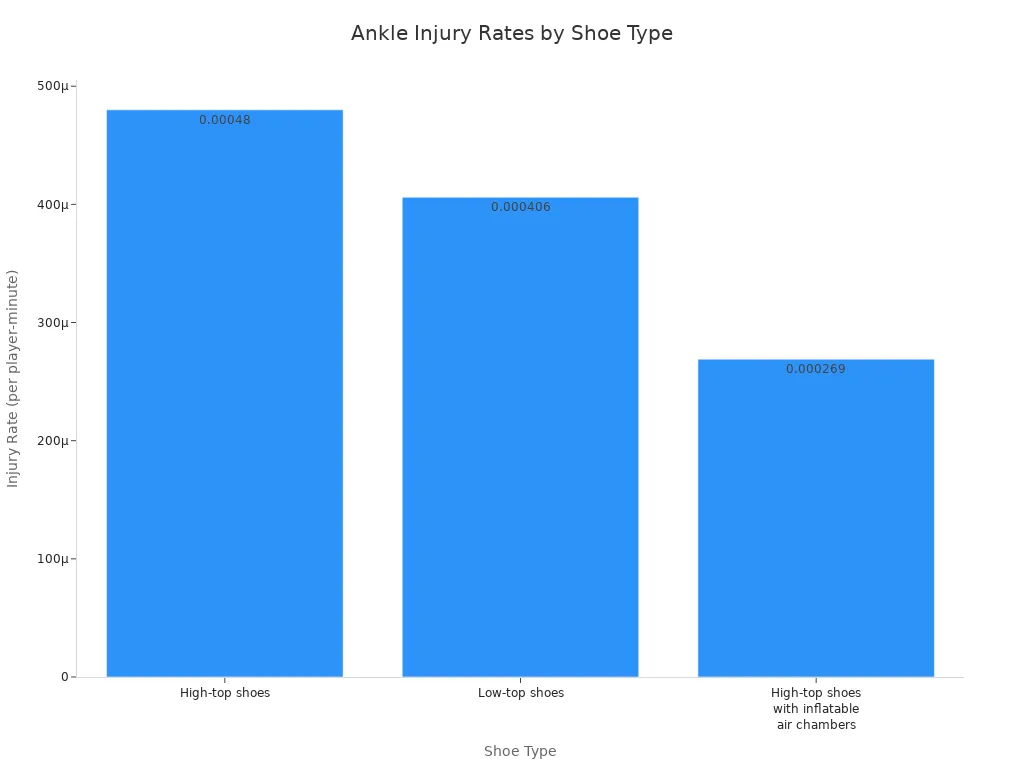
Pick court shoes for fit and lateral stability first. Do not assume a high-top collar guarantees ankle protection. These sports shoes serve you best when the sole matches the surface and the upper locks your foot down.
Cross trainers are flexible athletic shoes made for many kinds of workouts. You can run, lift, jump, and stretch in just one pair. Their design falls between running shoes and court shoes. That makes them a smart choice for gym time and group classes.
Cross trainers use firmer materials than running shoes. The midsole is packed with high-density foam. The outsole uses harder rubber. This mix barely compresses under heavy loads.
Many cross-training shoes are built to support heavy lifting. In general, compared to general training shoes and running shoes, cross-training shoes use more high-density foams in their midsoles and firmer rubbers in their outsoles. The mix of these two parts helps this style of shoe compress very little under outside loads. So, if you squat heavy, clean, snatch, or train for fun, these shoes give you a more stable base.
That steadiness matters when you squat or press overhead. A soft running shoe would wobble under a loaded barbell. A cross trainer keeps your foot planted.
Lateral support also makes cross trainers stand out. High-intensity interval training involves fast changes between movements. These quick shifts make slips, falls, sprains, and post-exercise pain common, especially for people with high or flat arches. Stability features help stop these problems:
Stability running shoes are made with arch support and midsole cushioning to keep feet in place, reduce pronation, and keep balance during running, jumping, climbing, or squatting.
GuideRails technology uses two firm foam pieces on either side of the heel to stop too much inward and outward rolling of the feet, keeping them aligned and limiting too much motion of other joints such as the knees and hips.
Pick cross trainers for gym sessions, weightlifting, and cross-training activities. They handle circuit training well. You can go from lunges to box jumps to rows without changing shoes. The firm heel gives you a solid platform for lifts. The flexible forefoot lets you run short distances.
Skip them for long runs or marathon training. A dedicated running shoe gives better cushioning for repeated impact. Skip them for tennis or basketball too. Court shoes offer better lateral grip and durability for those surfaces. Match the sports shoes to your main activity. A cross trainer covers many bases, but a specialist shoe wins for one sport.
Cleats are sports shoes with studs on the bottom. The studs dig into grass or turf to keep you steady when you cut and sprint. Soccer, baseball, and football each need a different cleat design. The soleplate and its stud pattern give you the grip you need for your surface and the way you move.
The upper material decides how tough and protective your cleats feel. Different materials work better for different playing styles and field conditions. The table below shows the main choices.
Upper Material | Durability | Protection | Key Benefit |
|---|---|---|---|
Synthetic | High | Good | Lightweight, water-resistant, thinner for better ball touch |
Leather (e.g., kangaroo leather) | High | High | Support, durability, and excellent ball feel |
Engineered fabrics / knit uppers | Moderate | Moderate | Sock-like fit, breathability, flexibility |
Synthetic leathers | High | High | Durability and support for aggressive play |
Synthetic materials lead the market because they weigh less and keep water out. Many soccer cleats use synthetic uppers to give you a thinner shape and better ball control. Leather cleats feel great but need more care and soak up moisture. Knit uppers give a snug, sock-like fit that shapes to your foot. Youth coaches often like synthetic cleats with flexible soles. Hard traction points on artificial turf can raise injury risk for younger players.
The soleplate and its stud layout control how your foot meets the ground. Different stud patterns change traction and injury risk in different ways. The table below sums up the main types.
Stud Configuration | Traction Effect | Injury Risk Consideration |
|---|---|---|
Screw-in (Soft Ground, SG) | Highest rotational traction; on turf causes a "foot-lock" effect | Raises shear and torsional loads on knee and ankle, increasing ACL and ankle sprain risk |
Bladed studs | Enhance linear traction, restricting horizontal foot slip | Increase ankle sprain and fifth-metatarsal stress fracture risk; raise ACL strain risk |
Conical studs | Reduce rotational stiffness | Lower joint torque, allowing smoother rotational movement with less resistance |
Mixed studs | Provide higher longitudinal and lateral traction | Restrict horizontal slip, increasing inversion moments and injury risk |
Conical studs were linked to less rotational stiffness and lower joint torque, while bladed studs boosted linear traction but raised ACL strain risk. Soleplate stiffness also changes how load spreads: more stiffness helps sprinting but hurts multidirectional agility.
Pick your soleplate based on your playing surface and position. Soccer cleats for natural grass usually use screw-in or bladed studs for the most grip. Football cleats for firm ground often use mixed or bladed setups. Conical studs work well for players who cut often and need less stress on their joints. Match your studs to your field and your playing style for safer, better play.
Hiking shoes are sturdy sports shoes built for trails, trekking, and uneven ground. They protect your feet from rocks and roots. They also give you traction on loose dirt and wet leaves. If you hike often, you need footwear that matches your terrain and pack weight.
Ankle support and traction define good hiking footwear. A firm heel holds your foot steady on side slopes. Deep lugs bite into mud and gravel. A rock plate shields your sole from sharp stones. These features keep you stable when the trail turns rough.
Does a high-top collar actually prevent ankle sprains? The research gives mixed answers. One clinical review found that high-top shoes do not reduce sprain risk without taping or external support. A biomechanical study reported the opposite: high-tops limited inversion better than low-tops. A jump-landing study found no difference in rolling motion between the two. That same study noted high-tops delayed peroneal muscle reaction, which may raise sprain risk. Many hikers now use an ankle brace instead. One hiker with six prior sprains wore an ASO brace and covered over 5,000 miles without rolling an ankle.
Trail runners are lightweight, breathable, and quick-drying. They let your foot move naturally. Their light weight matters on long days. Boots offer more protection, support, and durability, but they are heavier.
Choose based on your experience and terrain. Beginners benefit from the stable base of boots. Experienced hikers do well in trail runners. Rocky, sketchy trails favor beefier boots. Smooth forest paths suit light footwear. Heavy packs call for stable boots. Thru-hikers often pick trail runners for big daily mileage. If you have no time to break in footwear, trail runners feel comfortable right away. For snow and ice, boots or waterproof models keep you warm and dry. For most wet conditions, mesh trail runners dry faster than boots that stay damp. Wide toe boxes help your forefoot swell and spread over a long day.
Every sport needs its own kind of shoe. Running shoes soften your forward steps, court shoes grip the floor for side cuts, and cleats dig into turf. Foot doctors say you should match your sports shoes to your foot shape and your sport. The different types of sports shoes exist because support, stability, and traction change with each activity.
Picking the shoe that fits your main activity helps you play better and get hurt less. Swap out worn pairs after about 300 to 500 miles. Worn-down cushioning stops soaking up impact. Put function and fit ahead of brand or style. A good fit protects your feet, spreads pressure evenly, and keeps your natural alignment. The different types of sports shoes pay off when you choose well.
Replace running shoes after 300 to 500 miles. Walking shoes and cross trainers last longer, but worn midsoles lose their shock absorption. Inspect the tread and cushioning regularly. A fresh pair protects your joints and keeps your stride natural.
No. Running shoes have a raised heel and firm foam. That design can change your natural walking foot strike and cause leg pain. Cross trainers give a firmer base for lifting. Match your sports shoes to your main activity for the best support.
Research says no clear benefit. A study of 622 college players found no significant difference in ankle injuries between high-tops and low-tops. Pick court shoes for lateral stability and fit instead. An ankle brace may help more than a high collar.
Road models have smooth outsoles for pavement and treadmills. Trail models use deep, aggressive tread and rock plates. The tread grips loose dirt, and the plate shields your sole from sharp stones. Choose trail shoes for regular off-road running.
Minimalist sports shoes offer less cushioning and encourage a natural foot strike. They need a gradual transition. Your feet and calves must adapt over time. Start with short walks before longer runs. Beginners may do better with cushioned shoes first.


